
WordPress to Zoho Flow Integration
A WordPress Zoho Flow integration sends each form submission to a flow in Zoho Flow, so one form entry can start any workflow you build there: add a row to Zoho Sheet, post in Cliq, email your team, or update an app that FormBridge doesn’t cover directly.
This guide shows how to set up the Zoho Flow action in FormBridge for Zoho Pro: create a webhook trigger in Zoho Flow, paste its URL into the feed, choose what to send, then save and send a test so the flow can learn your fields.
Supported triggers and destinations
FormBridge for Zoho is a WordPress plugin that connects your forms to Zoho apps without code. With Pro, a feed can send a submission to Zoho Flow, and the flow decides what happens next.
WordPress triggers
- Elementor Forms
- Contact Form 7
- WPForms
- Gravity Forms
- Fluent Forms
- Ninja Forms
- Forminator Forms
- Formidable Forms
- Happyforms
- SureForms
- Divi forms
- Every Pro trigger
Zoho Flow actions
- Send JSON
- Send form data
Before you start
- FormBridge for Zoho Pro is installed and its licence is active. The Zoho Flow action is a Pro feature.
- Your WordPress form is published and its trigger is set up in FormBridge for Zoho.
- You can sign in to Zoho Flow and create a flow.
A Zoho Flow feed sends to the flow’s webhook URL, not through a Zoho account, so you don’t need a connection from FormBridge for Zoho → Connections. You can ignore Connect account on the Destination step.
How to send WordPress form data to Zoho Flow
Once your form trigger is ready, follow these six steps.
Step 1: Create a webhook trigger in Zoho Flow
Zoho Flow › Create flow › WebhookIn Zoho Flow, click Create Flow, give it a name, and choose Webhook as the trigger. Pick the payload format that matches the module you will choose in FormBridge: JSON for Send JSON, or Form data for Send form data.
Zoho Flow then shows the flow’s webhook URL. Copy it. It looks like
https://flow.zoho.com/…/webhook/incoming?zapikey=….Treat the URL like a passwordThe
zapikeyin the URL lets anyone who has it run your flow. Don’t paste it in public places. FormBridge stores it encrypted and never shows it again.Step 2: Choose Zoho Flow as the destination
Destination step › Zoho destinationOn the Destination step, keep Zoho app selected in the top-right switch. Set Zoho app to Zoho Flow, then choose the Module:
- Send JSON: the submission arrives as a JSON body. This is the best choice for most flows.
- Send form data: the submission arrives as a classic form post (
application/x-www-form-urlencoded).
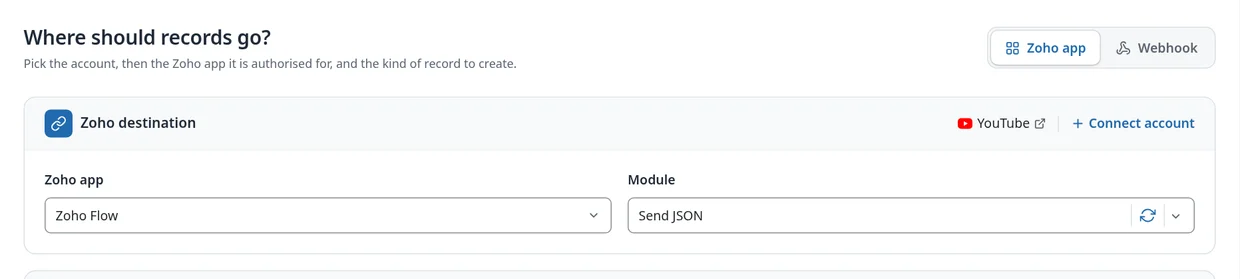
Choosing Zoho Flow and the Send JSON module. Step 3: Paste the Flow webhook URL
Destination step › Destination settingsUnder Destination settings, paste the URL from Step 1 into Flow webhook URL. Then click Test connection. It checks that the address is a real Zoho Flow webhook URL, without sending anything or running the flow.
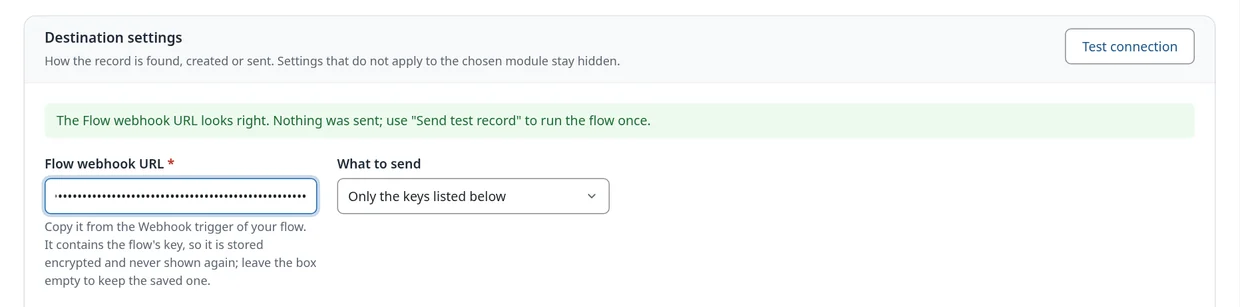
Test connection checks the URL without running the flow. When you edit a saved feed, the box stays empty and says Saved. Leave it empty to keep the saved URL, or paste a new one to replace it.
Step 4: Choose what to send
Destination step › What to sendUse What to send to decide which values reach the flow:
- Every submitted field, keyed by the form’s field IDs: the whole submission, with nothing to set up.
- Only the keys listed below: you choose the names the flow sees. Add one row per key with Add a line. In each row, type the Key (the variable name in your flow) and pick its Value: a Form field, a Fixed value, or a Template such as
{your-name} <{your-email}>.
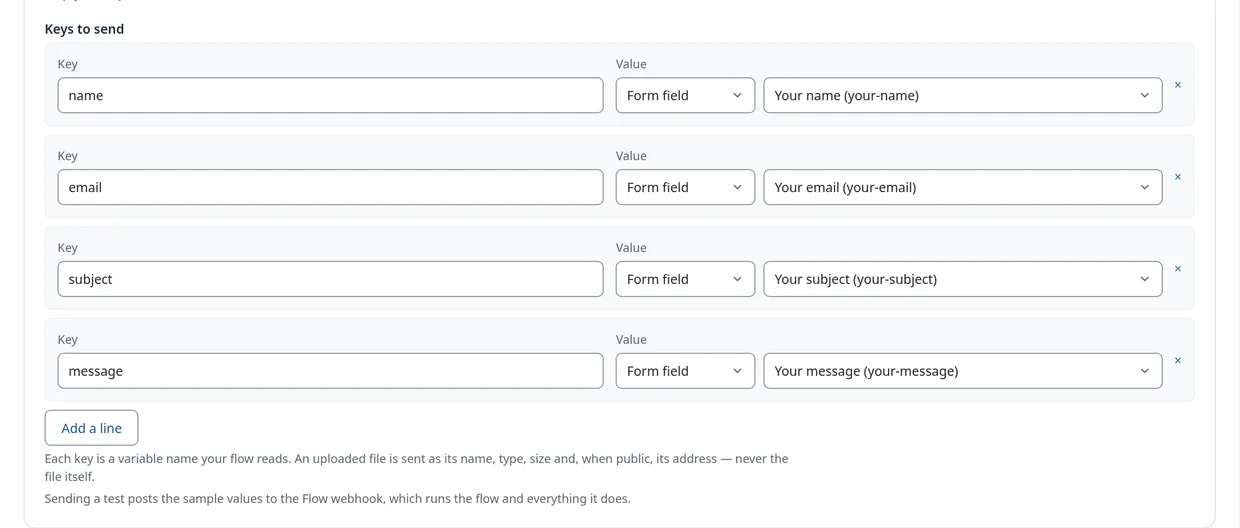
Choosing the keys the flow receives. How values arrive- With listed keys, every key is sent on every submission, even when its answer is empty, so the flow always sees the same variables.
- A checkbox or multi-select answer in a listed key arrives as one comma-separated text, such as
SEO, Web. - An upload arrives as a list of files with
name,type,sizeand, when the file is public, itsurl. The file itself is never sent.
Click Continue when you’re done.
Step 5: Save the feed
Mapping step › Save feedA Zoho Flow feed has nothing to match on the Mapping step: what you chose in Step 4 decides what is sent. To send only some submissions, turn on Conditional logic here. Then click Create feed (Save feed when editing).
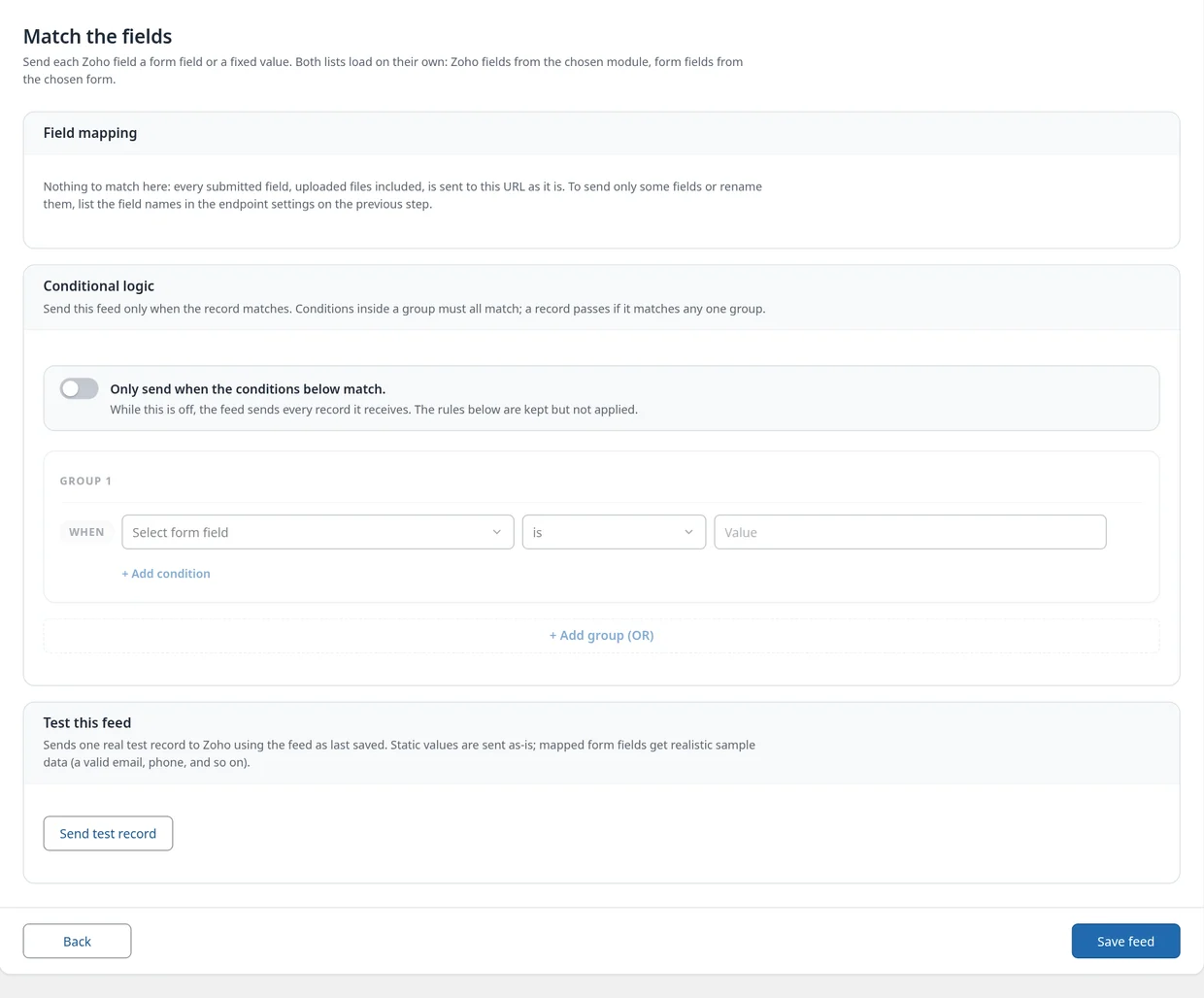
The Mapping step: conditional logic, test and save. Step 6: Send a test and finish the flow
Mapping step › Send test recordAfter saving, click Send test record. FormBridge posts sample values to the webhook, using the feed as last saved. This runs the flow once, with everything it does.
Back in Zoho Flow, the webhook trigger now has a sample payload, so your keys appear as variables. Add the flow’s actions, insert those variables where you need them, and turn the flow on.
Delivery logsEvery delivery is recorded under FormBridge for Zoho → Logs. Failed deliveries can be sent again with Resubmit.
- Only a real Zoho Flow address is accepted: https, a
flow.zoho…host in any Zoho data centre (such asflow.zoho.com,flow.zoho.euorflow.zoho.in), and/webhook/in the path. - Any 2xx answer from Zoho Flow is a success. A 5xx or 429 answer, or a network error, is retried in the background.
- If Zoho Flow got the request but didn’t answer in time (15 seconds), FormBridge doesn’t send it again on its own, because the flow may already have run. Check the flow’s history and resubmit from the Logs screen if needed.
- If every listed key is empty, nothing is sent.
- To send the same form to Zoho Flow and to another Zoho app, create two feeds for that form.
Verify the integration
- Turn the flow on in Zoho Flow.
- Submit a test entry on the real form, using values you can recognise.
- Check the log under FormBridge for Zoho → Logs and confirm the entry was sent to Zoho Flow.
- Open the flow’s history in Zoho Flow and check that the run received your values and that each action succeeded.
Troubleshooting
Pick the symptom you’re seeing to get the fix.
URL not accepted
- Likely cause
- The URL was copied incompletely, or it isn’t a Zoho Flow webhook URL (for example a Make or Zapier URL).
- How to fix it
- Copy the full URL again from the flow’s Webhook trigger, including
?zapikey=…, and paste it in. For a non-Zoho URL, use the Webhook action instead.
Error 4xx from Flow
- Likely cause
- The flow was deleted, its webhook was regenerated, or the key in the URL is no longer valid.
- How to fix it
- Open the flow in Zoho Flow, copy its current webhook URL and paste it into the feed again.
Flow didn’t run
- Likely cause
- The flow is turned off in Zoho Flow, or the feed’s conditions skipped the submission.
- How to fix it
- Turn the flow on, then check the feed’s conditional logic and the Logs screen.
Variables missing
- Likely cause
- The webhook trigger has no sample yet, or its payload format doesn’t match the module.
- How to fix it
- Match the formats (JSON with Send JSON, Form data with Send form data), then click Send test record again so Flow can read the keys.
Nothing arrives
- Likely cause
- The feed is turned off, it listens to a different form, or every listed key was empty.
- How to fix it
- Check that the feed is enabled and points at the right form, and that your keys use fields the visitor fills in. Then check the Logs screen.
Still stuck? Email the failed entry from the Logs screen to support@techwavesolutions.net.
Frequently asked questions
Do I need a Zoho connection for a Zoho Flow feed?
No. The feed sends to the flow’s webhook URL, so no connection from the Connections screen is needed.
Does Test connection run my flow?
No. Test connection only checks that the URL is a valid Zoho Flow webhook address. Send test record on the Mapping step is what runs the flow once.
Should I choose Send JSON or Send form data?
Send JSON suits most flows. Choose Send form data only if your webhook trigger is set to the Form data format. Whichever you pick, set the same format on the trigger in Zoho Flow.
Can I send file uploads to Zoho Flow?
FormBridge sends each upload’s name, type, size and, when the file is public, its link. The file itself isn’t sent, so the flow can fetch it from the link if it needs it.
When should I use Zoho Flow instead of a direct Zoho app?
Use a direct Zoho app feed, such as Zoho CRM, when FormBridge supports the app and the action you need. Use Zoho Flow when you need several steps, logic between them, or an app FormBridge doesn’t cover.
